
Janitorial Programs for Corporate Campuses and Headquarters
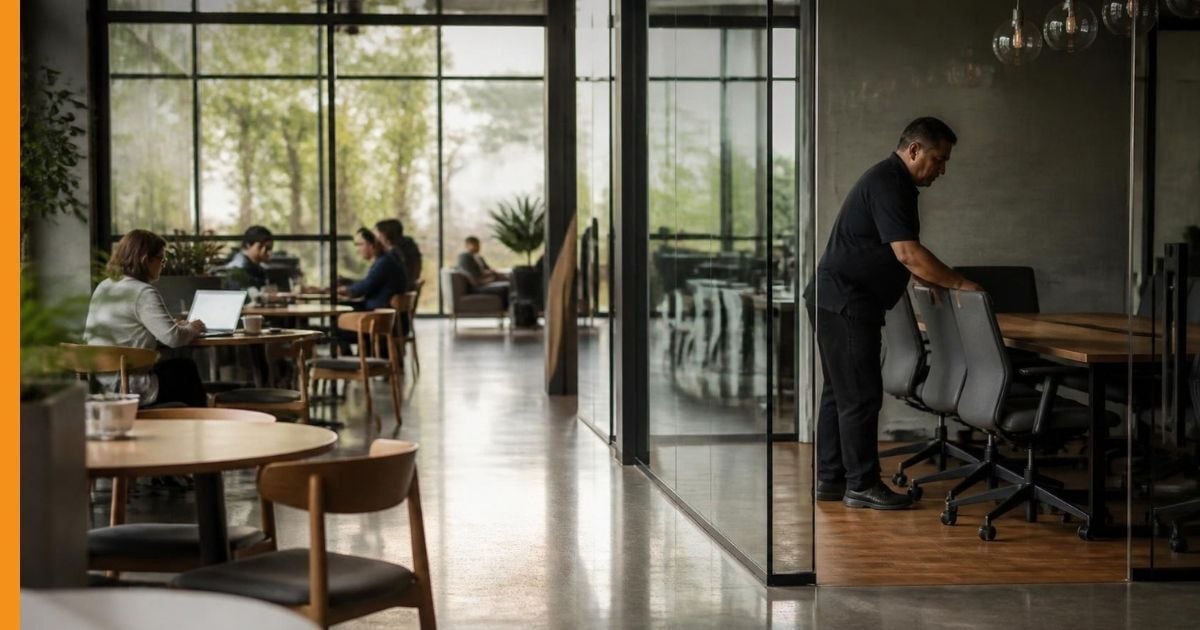
A janitorial program for a corporate campus or headquarters has to do six things that a basic office cleaning contract usually leaves vague. It needs a coverage model that matches when people are actually in the buildings, and a scope that names the amenity spaces: fitness centers, cafes, conference floors, and event space. It should treat occupant experience as something you measure. It needs written rules for who gets access to which areas and when, and one standard across every building on the campus. Frequencies should be set by occupancy data rather than by habit. This guide is for organizations that own or fully occupy their campus, where the facilities team answers to its own employees and leadership rather than to tenants.
Headquarters cleaning is judged by people who walk through the building every day and have opinions about it, including the executive team. A missed restroom on the floor where the board meets gets noticed in a way a missed restroom in a warehouse office does not. A conference room that is not reset before a 9 a.m. client meeting reaches the facilities director before lunch. The program has to hold up under that kind of attention without the cleaning itself becoming visible or disruptive.
The program at a glance
- How campus cleaning differs from multi-tenant office cleaning
- How to choose a coverage model
- How occupancy patterns should set frequency
- What to include for amenity and conference space
- How to handle access control and sensitive areas
- How to scope a multi-building campus
- How to measure occupant experience
- What to ask about pricing and supervision
Further down: where McLemore fits.
How is a corporate campus different from a multi-tenant office building?
The table below compares typical conditions. Individual buildings vary.
| Typical multi-tenant office building | Typical corporate campus or headquarters | |
| Who buys the service | Landlord or property manager | The occupying company's facilities team |
| Who judges it | Tenants, through the landlord | Employees, executives and visitors directly |
| Space types | Mostly leased office floors and common areas | Offices plus fitness, food service, conference and event space, labs or data rooms |
| Schedule | Business hours, fairly uniform | Varies by building, by floor and by day of the week |
| Access | Building-wide badge | Layered access, with restricted executive, R&D, or data areas |
| Footprint | One building | Often several buildings, sometimes a parking structure and grounds |
Most of what follows comes from the second row. When your colleagues and leadership judge the service, the program becomes part of how the workplace is run rather than a line item passed through to tenants.
How do you choose a coverage model?
Most campuses use some mix of three models:
- A night-only crew that does the bulk of the cleaning after the buildings empty out
- A day porter team that handles restrooms, break areas, spills, conference room resets, and requests during business hours
- A combined model, with a smaller day team and the heavy work at night
A night-only crew can work for a campus with light daytime use and few shared spaces. Once a building has a busy cafe, a fitness center, a heavy meeting schedule, or executive floors that host visitors, someone usually needs to be on site during the day. The day porter is the person occupants see, so how you staff, train, and supervise the role shapes how employees feel about the whole program.
Whichever model you choose, write down who responds to a daytime request, how requests reach them, and how quickly they respond. If you leave that undefined, requests tend to land on the facilities team.
How should occupancy patterns set cleaning frequency?
Many corporate campuses no longer run at the same occupancy every day. If most employees come in on Tuesday through Thursday, cleaning every restroom and break room to the same frequency all five days spends labor where it is not needed and can leave peak days thin.
Your own data is the best guide. Badge swipes, room booking data, and cafe transaction counts show which buildings and floors are busy on which days. A good vendor can use that to set frequencies by building, by floor, and by day, with heavier restroom and break room coverage on peak days and lighter routes on quiet ones. Low-use floors can move to a reduced schedule with periodic checks rather than full nightly service.
Revisit the frequencies when occupancy changes, whether that is a new return-to-office policy, a consolidation, or a new building coming online. Build that review into the contract so a scope change does not have to wait for renewal.
What should the scope say about amenity and conference space?
Amenity spaces are a common place for campus scopes to turn vague. Each one has a boundary that should be written down:
- Fitness centers: who cleans the equipment, the locker rooms, and the showers, how often during the day, and who supplies the disinfectant and towels.
- Cafes and food service: where the janitorial scope stops and the food service operator's begins. Dining room tables, floors and trash usually sit with janitorial, and kitchen and back-of-house areas usually sit with the food service operator, but write it down either way.
- Conference floors: whether the crew resets rooms between meetings or only at night, and who handles catering cleanup after large meetings.
- Event space: how after-hours events are requested, how far ahead, and how the extra labor is priced and approved.
None of these is hard to sort out. Problems tend to start when a space was never assigned, because each vendor on site can reasonably assume someone else has it.
How should access control and sensitive areas be handled?
A headquarters often has areas where access is tightly controlled: executive suites, legal and HR files, R&D labs, data rooms, and secure storage. The janitorial scope should state, for each area:
- Who is allowed in and at what hours
- Whether entry requires an escort
- Who holds keys or badge access, and how it is revoked when a crew member leaves
- What the crew may and may not touch, for example, desk surfaces with papers on them
Ask each vendor how its people are screened, what background checks are run, and who the legal employer of each person on site is. You want those answers in writing for every person who will be in your buildings after hours. At McLemore, every person on site is a McLemore W-2 employee, hired, screened, and trained by us.
How do you scope a multi-building campus?
A campus with several buildings raises a structural question: one contract for the whole campus, or separate contracts by building or by service. One campus-wide contract gives you a single point of accountability, one reporting format, and one standard across buildings. Separate contracts can make sense when buildings have very different uses, such as a headquarters tower next to a lab or a distribution building.
If you go with one contract, a few things keep it working:
- A single quality standard and inspection checklist used in every building
- A schedule set building by building, so each one runs at its own frequency
- Reporting that breaks results out by building, so a weak building does not hide in a campus average
- A clear process for adding or removing a building or floor mid-contract
How should you measure occupant experience?
Useful measures include:
- Inspection scores by building and floor, using the same checklist every time
- Request volume and response time for daytime requests
- Repeat complaints about the same area
- Restroom check completion on peak days
- Short occupant surveys, run once or twice a year
Review these monthly with the vendor and quarterly with whoever in leadership owns the workplace. Agree in the contract which reports arrive on a schedule, so you are not asking for numbers each month.
What should you ask about pricing and supervision?
Two questions are worth asking alongside price.
The first is how pricing behaves when the campus changes. A fixed monthly price gives you a predictable invoice for a defined scope over a defined period. Ask how scope changes are priced, how escalation works over the contract term, and what happens to the price when a floor closes or a building opens. Those answers matter more on a campus whose occupancy is still moving.
The second is who supervises the crew. At McLemore, sites with 10 or more full-time staff have a dedicated on-site supervisor. Smaller sites are overseen by a route or area manager. Ask every bidder the same question about your campus and hold them to the answer. Our earlier piece on why on-site supervision changes everything covers what that role does day to day.
If you are running a formal bid for a campus contract, how to buy commercial janitorial services walks through the full process from scope to transition.
Where McLemore fits
McLemore has run janitorial programs for more than 50 years from our Houston headquarters, with local branch, route, and area managers across 12 regions. We clean corporate headquarters and campuses alongside industrial, education, and public-sector facilities. Every person on site is our W-2 employee. Pricing is a fixed monthly rate for a defined scope and contract period, subject to agreed scope changes and escalation. Our customer retention rate is 96% year over year. You can read more about how we staff headquarters and campus accounts on our corporate office janitorial services page.
For more guides on buying, budgeting, staffing and managing custodial services, organized by role and by facility type, see the Facility Services Resource Center.
If your campus program is not keeping up with how your buildings are actually used, we will walk the campus with you and show you how we would scope it. Reach the sales team at sales@mbminc.com or (713) 528-7775.