
Janitorial Programs for Distribution, Manufacturing and Petrochemical Facilities
A janitorial program for a distribution center, manufacturing plant or petrochemical site needs six things an office program can usually do without: cleaning coverage on every shift the facility runs, routes planned around production, a floor care program set by traffic lane, documented site safety orientation for every custodian, a plan for shutdowns, turnarounds and peak season, and a crew that shows up reliably, with a backup when someone calls out. It should also report results in the same terms your operation already uses.
These programs are judged differently because the cleaning sits right next to production. A spill that nobody cleans up can become a slip, a forklift incident or a line stoppage. A restroom out of service at shift change is felt on the floor right away. The second shift supervisor notices a crew that doesn't show up at 2 a.m. before it reaches you. This guide covers what it takes to support throughput, safety, and attendance without getting in the way of any of them.
The program at a glance
- How industrial cleaning differs from office cleaning
- How to staff cleaning across shifts
- What happens when a custodian calls out
- How to clean around production
- How to care for warehouse and plant floors
- What safety orientation custodial staff need
- How to plan for shutdowns, turnarounds, and peak season
- Why crew attendance matters so much
- How to measure the program
Further down: where McLemore fits.
How is industrial cleaning different from office cleaning?
The table below compares typical conditions. Individual sites vary, and some office buildings run around the clock too.
| Typical office or campus | Typical distribution, manufacturing or petrochemical site | |
| When cleaning happens | After hours, in an empty building | Often during operations, across two or three shifts |
| What failure can cost | Complaints | Slips, equipment damage, line stoppages, audit findings |
| Floors | Carpet, tile, vinyl | Sealed concrete, epoxy, high-traffic lanes, dock areas |
| Access | Badge and key | Site safety orientation, restricted zones, escorts, lockout areas |
| Who cares most | Facilities | Plant manager, operations, EHS |
| Demand pattern | Fairly steady | Peak season, shutdowns, turnarounds |
The first row drives a lot of the rest. Cleaning around a running operation requires planning that an empty office doesn't.
How should you staff cleaning across shifts?
A facility that runs 24 hours needs cleaning coverage that keeps pace. Restrooms and break rooms used by three shifts need attention during each shift, not a single deep clean at night. Dock and staging areas pick up debris continuously. Office areas inside a warehouse may be the only part of the building that can wait until night.
There are three common ways to staff it:
- A dedicated crew on each shift, which gives the most consistent coverage and costs the most of the three
- A day or swing-shift porter team handling restrooms, break rooms, and spills, with the heavy cleaning done by a night crew
- A single overnight crew, which works only when daytime use is light
The right choice depends on headcount by shift and how the building is laid out. Whatever the model, write down who responds to a spill on each shift and how fast. Spill response is easy to leave undefined, and when it is, it tends to fall between the cleaning crew and operations.
What happens when a custodian calls out?
In a shift operation, one absence can leave a restroom block or dock area uncovered for a full shift, and no one else on the crew may be available to pick it up. Ask each bidder how they handle call-outs:
- Whether there is a relief pool trained on your site, including its safety orientation
- How quickly a replacement can arrive on each shift, including nights and weekends
- Who decides which tasks move first when a replacement is not available
- Whether the contract states a minimum staffing level per shift or only an outcome
- How missed work is reported to you and credited
An on-site supervisor usually rebalances work when someone is out. We covered that in more detail in why on-site supervision changes everything.
How do you clean around production?
In a plant, the cleaning schedule has to follow the production schedule. That means knowing which lines run when, where changeovers happen, which areas are off-limits while equipment is running, and who on the operations side can clear a crew into an area.
A capable industrial vendor builds its routes around that information rather than a standard building template. It also knows where its scope stops. Production equipment, process areas, and food-contact surfaces usually belong to your sanitation team or a specialist, and the janitorial scope should state that plainly so neither party assumes the other has it covered.
How should warehouse and plant floors be maintained?
Floor care is one of the parts of an industrial janitorial scope that most needs to be spelled out, because it is easy to underestimate. Sealed concrete and epoxy floors wear at forklift turning points, dock plates, and high-traffic lanes, and grit that is not removed wears down the finish.
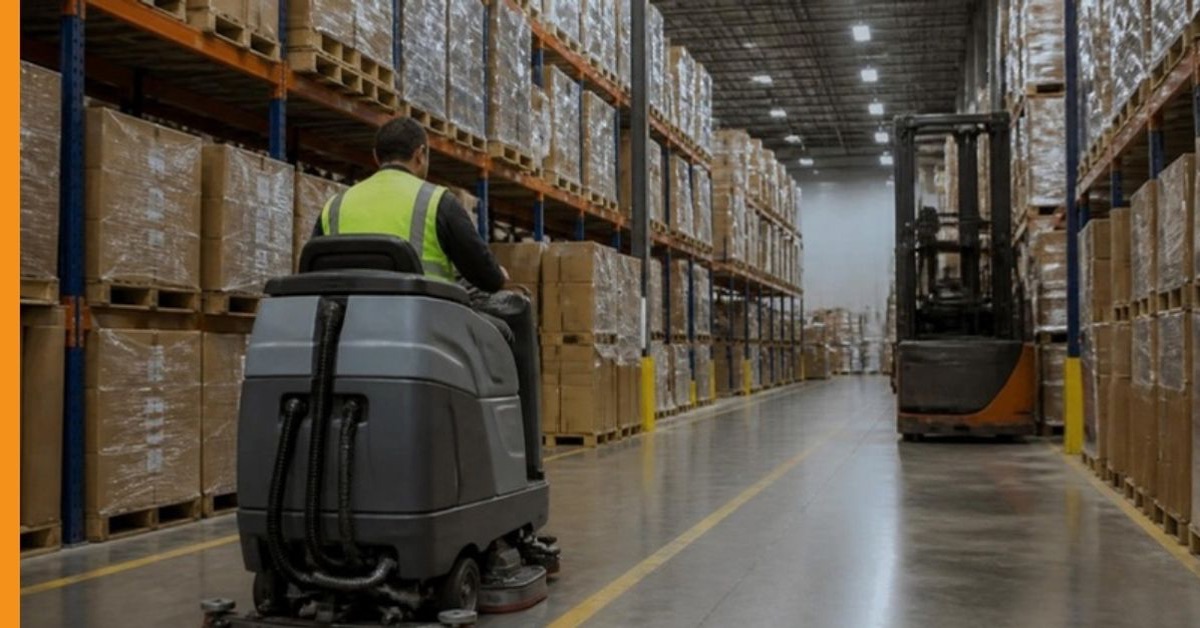
A practical floor program includes routine sweeping and scrubbing by traffic lane, with frequency based on traffic volume. It also covers spill response with the right absorbents for what is actually spilled on your site, and a periodic schedule for machine scrubbing and recoating. Equipment matters: ride-on scrubbers for large open floors, and walk-behinds for aisles and tight areas.
Treat the floor as an asset with a maintenance schedule, the same way you treat the racking or the dock equipment.
What safety orientation do custodial staff need?
OSHA's walking-working surfaces standard requires workplaces to be kept clean, orderly, and, as far as feasible, dry, with floors free of hazards such as spills and leaks. Housekeeping is a safety obligation in its own right, and your janitorial program is part of how you meet it.
The vendor's own people also need to work safely in your facility. That means your site safety orientation, training on forklift traffic and pedestrian lanes, restricted and lockout areas, the chemicals your process uses, and your emergency procedures. Ask for that orientation to be documented for every person assigned to your site, and repeated when crews change.
At petrochemical and refinery sites, precision matters. OSHA's process safety management standard sets specific contractor training rules for work on or next to covered processes, but it generally does not extend those rules to incidental services like janitorial work. Many sites apply their own contractor safety requirements to every vendor anyway, including drug testing, site-specific orientation, and safety prequalification. Find out which of your site's requirements apply to custodial staff, and put them in the contract.
We work inside these requirements every day. At a Gulf Coast refinery and chemical manufacturing sites along the same corridor, McLemore crews complete each site's contractor safety orientation. At one safety-heavy chemical manufacturing complex, McLemore serves on the site's contractor safety council and attends monthly meetings alongside other contractors working on site. McLemore also holds the IBR Safety Excellence Award (Bronze), and we assign only McLemore W-2 employees to industrial sites, trained by us before they complete your site orientation.
How should you plan for shutdowns, turnarounds, and peak season?
Industrial demand is uneven. A planned maintenance shutdown may be the only chance each year to deep-clean areas that are normally running. A refinery turnaround brings a large temporary contractor population on site, often with temporary facilities, trailers, and restrooms that all need service. Peak season at a distribution center can add many temporary workers, and restroom and break room use rises with them.
Plan each of these with your vendor well in advance. For a shutdown, agree on the scope, areas, and window, and confirm how your vendor will staff and supervise the extra labor. For a turnaround, decide whether your existing vendor or a separate contract will provide custodial support for the temporary population, and who will manage it. For peak season, build the added coverage into the annual plan rather than making an emergency call in November.
Why does crew attendance matter so much?
A large part of whether an industrial program works is whether the cleaning crew shows up. A vendor with high absenteeism on its own crew leaves areas uncleaned, and your supervisors end up covering the gap or doing without.
At a 600,000-square-foot e-commerce distribution center where the previous vendor was failing, McLemore took over the account and crew absenteeism fell 77 percent within 60 days, from 22 percent to under 5 percent. Five of the seven incumbent workers the site wanted to keep stayed on after retraining. The full account, including how the switch was handled quietly during peak season, is in the distribution center takeover case study. At a distribution client, missed cleanings fell 97.5 percent.
What changed at that site was a set of basic practices applied consistently: W-2 employment, on-site supervisors, and zone checklists that showed which areas were completed and which were not.
How should you measure an industrial janitorial program?
Industrial facilities already run on metrics, and the janitorial program can report on the same terms. Useful measures include:
- Inspection scores by zone, with the same checklist every time
- Task completion rate against the scheduled route
- Crew attendance and turnover
- Spill response times, and any safety incidents involving custodial staff
- Supply usage against budget
Review them monthly with the vendor, and quarterly with operations and EHS. Agree in the contract which reports are scheduled. If the numbers only show up when you ask for them, raise that with the vendor.
Where McLemore fits
We have run janitorial programs from Houston for more than 50 years, including distribution centers, manufacturing plants, and refinery and chemical sites along the Gulf Coast. Every person on site is our W-2 employee, each account has a dedicated supervisor, and pricing is a fixed monthly rate for a defined scope and contract period, subject to agreed scope changes and escalation. More detail on how we staff these sites is on our manufacturing and distribution page, and our earlier piece on cleanliness and safety in distribution centers covers the day-to-day basics.
More guides on buying, budgeting, staffing, and managing custodial services, sorted by role and by facility type, are in the Facility Services Resource Center.
If your current program is costing you attendance, safety or uptime, we will walk your facility across shifts and show you what a different setup would look like. Reach the sales team at sales@mbminc.com or (713) 528-7775.